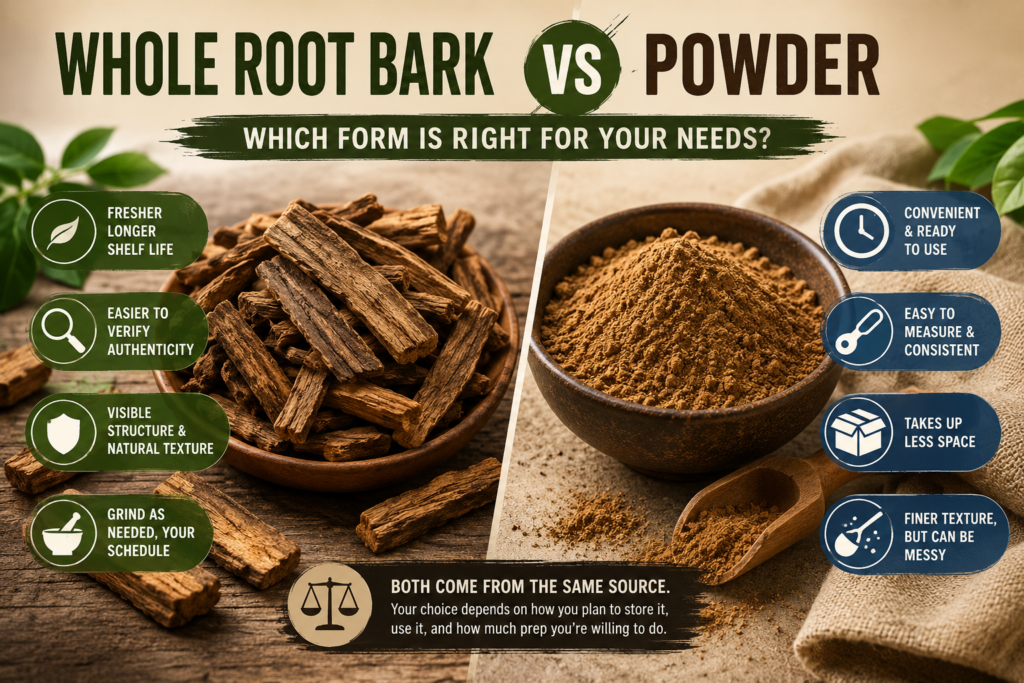
If you’ve spent any time browsing root bark listings, you’ve probably noticed the same fork in the road every time: whole bark or powder. It seems like a small detail, but the form you choose actually affects freshness, how you’ll use it, and even how confident you can be in what you’re getting. Let’s break down the real differences so you can pick the one that actually fits your situation, not just whichever one happened to load first on the page.
What “Whole” and “Powder” Actually Mean
Whole root bark is exactly what it sounds like: chunks, strips, or shavings straight from the root, dried but otherwise untouched. Some pieces might be an inch long, others closer to the size of a fingernail, depending on how the bark was processed after harvest.
Powder is whole bark that’s been ground down, sometimes to a fine dust, sometimes to something closer to coarse sand. It’s the same starting material, just mechanically broken apart.
That “same material” part matters. Neither form is inherently better in quality. The difference is really about what happens to that material after grinding, and how that affects your experience using it.
Freshness and Shelf Life
Here’s where whole bark tends to win. Grinding bark into powder massively increases its surface area, and more surface area means faster reactions with air, light, and moisture. A chunk of bark sitting in a jar ages slowly because only the outer layer is exposed. Powder, on the other hand, has every particle exposed at once.
Practically speaking, this means powder can lose potency noticeably faster than whole bark stored under the same conditions. If you’re buying in bulk and don’t plan to use everything right away, whole bark is the safer bet for keeping things fresh over the long haul. You can always grind a portion when you’re ready to use it.
Verifying Authenticity
This one surprises people. Whole bark shows its structure. Anyone familiar with the plant can look at color, texture, and the pattern of the bark itself and get a decent read on whether it looks right. Powder hides all of that. Once it’s ground down, you’re relying entirely on the seller’s word, since visual inspection tells you almost nothing.
This doesn’t mean powder is automatically suspicious. Plenty of reputable sources sell high-quality powder. But if you’re buying from a new supplier and want an extra layer of confidence, whole bark gives you something tangible to inspect before you fully commit.
Ease of Use
Powder wins here, no contest. It’s ready to go the moment you open the bag. No extra tools, no grinding, no waiting. If convenience is your top priority, powder removes a step that some people genuinely don’t want to deal with.
Whole bark requires a grinder, and not every kitchen tool handles tough, fibrous bark well. A basic coffee grinder can struggle, and you may end up needing something more heavy-duty. That extra step is a small hassle for some and a complete dealbreaker for others.
Storage Space and Handling
Whole bark takes up more room. Chunks and strips don’t pack down the way powder does, so if storage space is tight, powder is the more compact option. Also, scooping and measuring is consistent because it is uniform unlike large irregular pieces.
That is on the down side,powder does get messier, it stuck to anything and kicks up dust when pour it into it and it is easier to knock down a pile of dust of with. With a whole bark it won’t do that.
So, Which One Should You Choose?
Truthfully, it’s your personal choice. For those with a long life freshness preference or an urge to be able to literally see exactly what you’re purchasing then the answer is whole bark. If you value convenience and don’t mind trading off some shelf life and inspectability, powder makes more sense.
A lot of people actually land somewhere in the middle: they buy whole bark for storage and grind small batches as needed. That way you get the shelf-life benefits of whole bark with the convenience of powder, just on your own schedule instead of the seller’s.
There’s no universally “right” answer here. Both forms come from the same source material, and the choice really just depends on how you plan to store it, use it, and how much hands-on prep you’re willing to do along the way.