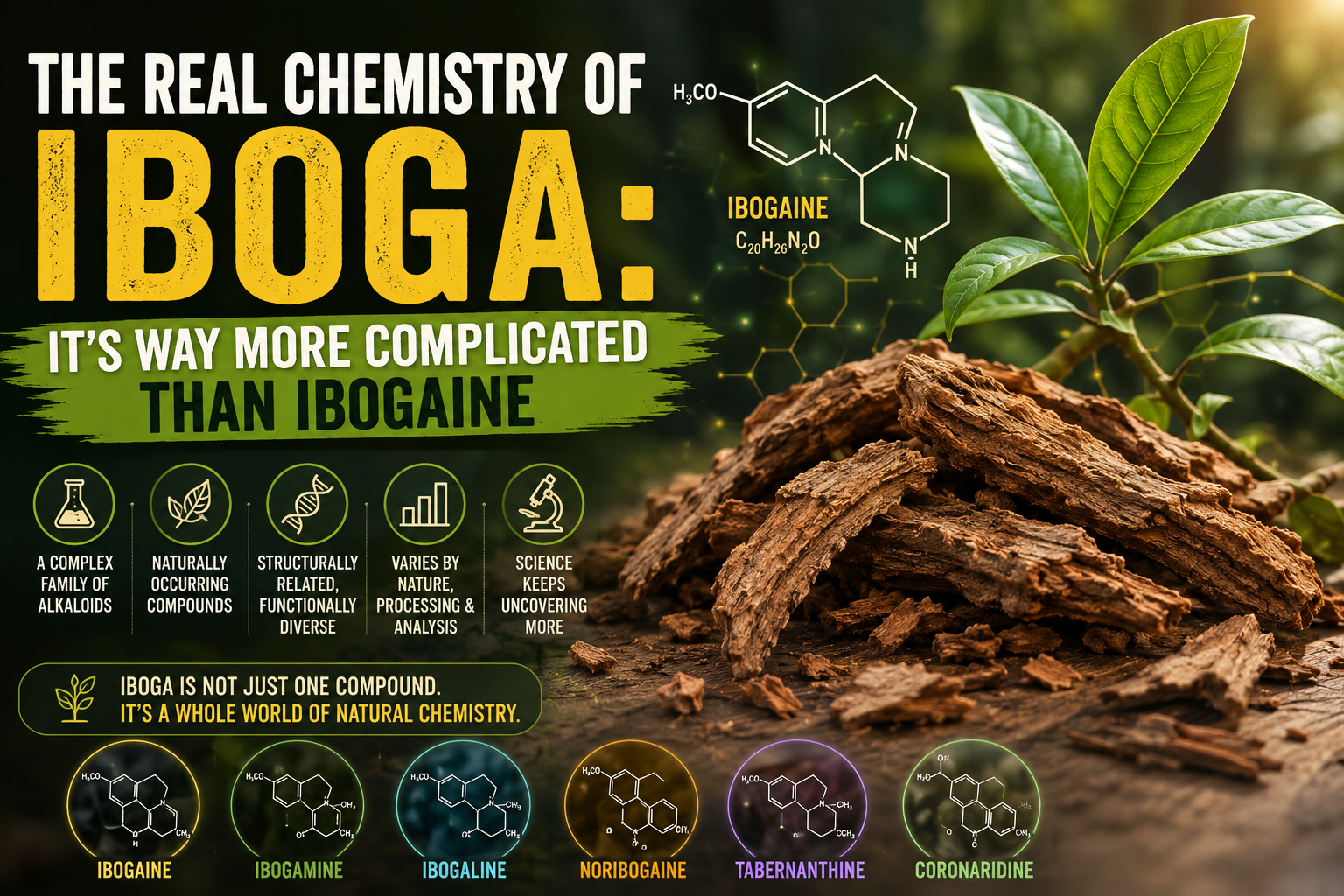
The Real Chemistry of Iboga: It’s Way More Complicated Than Ibogaine ?
If you’ve looked into iboga at all, you’ve probably heard the name ibogaine thrown around constantly. It’s the compound everyone talks about, and sure, there’s good reason for that. But honestly? That’s just the beginning of what’s actually going on inside this plant.
Iboga—scientifically known as Tabernanthe iboga—doesn’t just contain one active compound. It’s got this whole family of related alkaloids happening at once, and they vary depending on basically everything: where the plant grows, how the soil treats it, how old it is when you harvest, how you process it, even which lab tests it and how they do it. So if you really want to know what’s in iboga, you can’t just focus on the famous one.
The Full Alkaloid Picture
Alkaloids are nitrogen-containing compounds that plants naturally produce, and iboga’s collection of them belongs to a bigger group called monoterpenoid indole alkaloids. You’ll find this family scattered across different plants, and it’s known for being structurally all over the place.
What makes iboga interesting is that it makes several related alkaloids at the same time. Some are super abundant, others barely show up. And here’s the thing that trips people up: two alkaloids can look almost identical on a molecular level but behave totally differently in your body. Structure matters, but it’s not everything.
This is why serious researchers don’t just look at iboga as a source of one molecule. They study each compound individually and also look at how they work together in the whole plant. That gives you an actual picture of what you’re dealing with, not just a guess.
Ibogaine: The Famous One
Let’s be straight about ibogaine—it’s absolutely the most well-known alkaloid in iboga, and that’s not an accident. It affects multiple neurological pathways, and scientists have looked into it for various things, including potential connections to substance-use issues.
But let’s also be real: ibogaine isn’t some simple health product you can casually experiment with. The research is pretty clear on this—there are serious safety concerns, especially involving your heart. That’s why responsible researchers don’t just talk about what it might be good for; they dig into the actual pharmacology, what happens to it when your body breaks it down, how it interacts with other drugs, and what the actual risks are.
One complication: your body converts ibogaine into something called noribogaine. So when researchers study ibogaine, they’re really tracking two molecules, not one. The metabolite matters as much as the original compound.
The Other Alkaloids
Beyond ibogaine, you’ve got ibogamine and ibogaline hanging out in the plant. They’re structurally similar to ibogaine, which actually helps researchers figure out how the plant works. When you study molecules that are almost the same but slightly different, you can see how those small changes affect what happens next.
Instead of thinking of iboga as just a factory for one ingredient, it’s more accurate to see it as a natural mix of related compounds. That’s actually kind of the reality of most plants—they’re not designed to be simple, they’re designed to survive and reproduce. The complexity is the default.
Other Compounds That Show Up
You’ll see tabernanthine, coronaridine, and a few others mentioned in scientific papers about iboga. There’s also voacangine, which is more commonly associated with other plants in the same botanical family but shows up in the alkaloid family we’re talking about.
The point? Iboga’s chemistry isn’t about one famous molecule with some extras. It’s a whole collection of naturally occurring substances with different structures, and they all contribute to what makes the plant what it is.
Why Every Sample Is Slightly Different
Here’s something that doesn’t always get mentioned: natural plant material isn’t like a manufactured chemical. You can’t guarantee that two batches of iboga root bark will have the same mixture of alkaloids. They probably won’t.
A bunch of things affect what ends up in the plant. Geographic location matters. What the weather was like during growing season. How mature the plant was when harvested. How you store it and process it. Even which lab analyzes it and what method they use can change which compounds show up and in what amounts.
That’s exactly why labs use chromatography and mass spectrometry for this work. These techniques let scientists actually separate out individual compounds and see the full picture with precision. You can’t do that by just looking at the plant.
Whole Plant vs. Pure Compound—They’re Not the Same
This is important: whole iboga root bark and a purified, isolated alkaloid are fundamentally different things. One is a complex mix of natural compounds; the other is a single molecule. The distinction matters a lot when you’re reading research.
A study that focuses on pure ibogaine can’t just be applied to everything that contains iboga root bark. The concentration, composition, and combination of compounds could be totally different. If you’re trying to understand what something actually does, you need to know whether the research was done on the whole plant or on an isolated compound.
Why Researchers Keep Digging
There’s still a lot we don’t fully understand about iboga’s chemistry. Better analytical technology keeps getting developed, which means scientists can detect compounds more accurately now than they could even a few years ago. They can measure structure, concentration, how it gets metabolized, and what it actually does in biological systems.
Over time, all this work adds up to a clearer picture of how the different components of iboga interact and influence each other. It’s a reminder that natural products aren’t usually simple. A plant might be famous for one compound while also quietly producing tons of other stuff that contributes to its overall identity.
Safety First, Always
If you’re interested in iboga or its alkaloids, the safety part isn’t optional. Ibogaine in particular has been linked to serious adverse effects, including dangerous effects on the heart. It can interact with medications and other health conditions in ways that create real risks.
Think of information about iboga chemistry as educational. It’s not a DIY guide. “Natural” doesn’t automatically mean “safe,” and concentrated extracts definitely don’t work the same way as raw plant material. That’s just basic reality.
The Bottom Line
Iboga is nowhere near as simple as “ibogaine plus some other stuff.” It’s a genuinely complex natural matrix containing a whole family of alkaloids—ibogaine, ibogamine, ibogaline, noribogaine, tabernanthine, and various related compounds. Each sample has a slightly different mix, which is why lab analysis actually matters.
As analytical methods get better and more detailed, researchers will keep building a clearer picture of what’s really happening with iboga’s chemistry. The real story? Iboga is chemically complicated, and that complexity is a big part of why it continues to be an interesting subject of scientific study.
Explore our exclusive collection of Iboga products.
Contact our team
for more information.