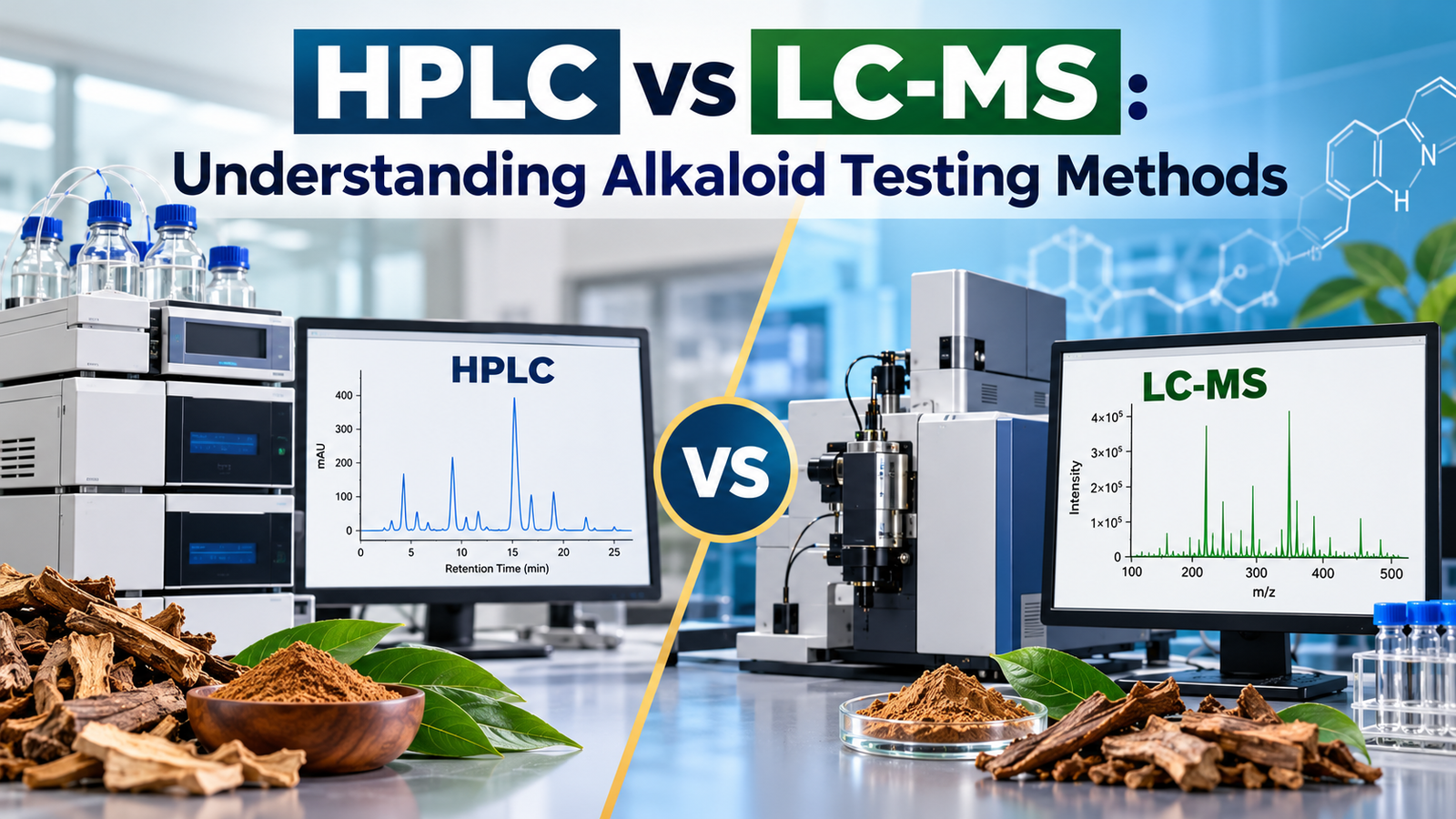
HPLC vs LC-MS: Understanding Alkaloid Testing Methods
Anyone who has sent a plant extract to a laboratory knows the feeling. The report arrives packed with peaks, ratios and technical abbreviations, leaving you wondering what the results actually mean for your product. Much of the confusion surrounding alkaloid testing comes down to two analytical techniques: High-Performance Liquid Chromatography (HPLC) and Liquid Chromatography-Mass Spectrometry (LC-MS).
Although both techniques are widely used in analytical laboratories, they serve different purposes and provide different levels of information. Understanding their differences can help manufacturers, researchers and quality control professionals select the most appropriate testing method. This guide explains how HPLC and LC-MS work, their advantages and limitations, and when each method is most suitable.
Why Alkaloid Testing Matters
Alkaloids are naturally occurring nitrogen-containing compounds produced by various plants. Caffeine, nicotine, quinine, morphine and piperine, the compound responsible for the characteristic heat of black pepper, are well-known examples.
These compounds have different chemical properties and biological effects. While some are widely used in food, pharmaceutical and research applications, others can present safety concerns even at relatively low concentrations.
This makes reliable alkaloid testing important across several industries, including:
- Herbal supplements and botanical extracts
- Tea, spices and food ingredients
- Pharmaceutical raw materials
- Agricultural and plant-based products
- International trade and export shipments
Manufacturers and buyers need accurate information about the chemical composition of a batch. Regulatory authorities also require appropriate analytical evidence to verify that potentially harmful compounds remain within applicable limits. A properly validated testing method helps provide reliable and traceable results.
How HPLC Works in Alkaloid Testing
HPLC stands for High-Performance Liquid Chromatography. It is an established analytical technique used to separate, identify and quantify individual compounds within a mixture.
During the process, a prepared sample dissolved in a suitable liquid solvent is pushed through a column containing specialised packing material under high pressure. Different compounds interact with the column differently, causing them to travel at different speeds and separate from one another.
As the separated compounds leave the column, a detector, commonly a UV detector, records their signals. These signals appear as peaks in a chromatogram. The retention time and comparison with appropriate reference standards help identify compounds, while peak measurements can be used for quantification.
Advantages of HPLC
HPLC has been used in analytical laboratories for decades because it offers several practical advantages:
- Suitable for routine analysis of known alkaloids.
- Generally more affordable than advanced mass spectrometry systems.
- Established analytical methods are available for many plant compounds.
- Useful for regular quality control and batch-to-batch comparisons.
- Can provide reliable quantitative results when properly validated.
Limitations of HPLC
Traditional HPLC systems equipped with UV detectors have certain limitations. They primarily detect compounds based on their ability to absorb ultraviolet or visible light.
When two alkaloids have similar retention times, they may be difficult to distinguish without adequate chromatographic separation. Complex plant extracts can also contain substances that interfere with smaller peaks.
Another important limitation is that a conventional UV detector cannot independently determine the molecular mass or structural identity of an unknown compound. Additional analytical techniques may be required for confirmation.
How LC-MS Works in Alkaloid Testing
LC-MS stands for Liquid Chromatography-Mass Spectrometry. It combines liquid chromatography with mass spectrometry to provide detailed information about the compounds present in a sample.
The first stage is similar to HPLC. A liquid sample passes through a chromatographic column, where its individual components are separated. However, instead of relying only on light absorption, LC-MS uses a mass spectrometer to analyse the ions produced from those compounds.
The instrument measures mass-to-charge ratios (m/z) and can also examine characteristic fragmentation patterns. These measurements provide valuable information that helps analysts distinguish compounds with similar chromatographic behaviour.
This additional analytical information makes LC-MS particularly useful for complex botanical extracts, trace-level measurements and investigations involving compounds that are difficult to identify using conventional HPLC-UV methods.
Advantages of LC-MS
- High sensitivity for detecting low concentrations of suitable target compounds.
- Provides mass-to-charge information for compound identification.
- Can help distinguish compounds with similar chromatographic retention times.
- Useful for analysing complex botanical and herbal extracts.
- Supports targeted analysis and certain forms of unknown compound screening.
Limitations of LC-MS
Despite its advanced capabilities, LC-MS also has practical limitations. The equipment requires a substantial investment, and operating and maintaining the system can be expensive.
Analytical methods also require careful development and validation. Matrix effects, where other substances in a sample influence ionisation and signal intensity, can affect measurement accuracy.
Furthermore, interpreting mass spectra and fragmentation patterns requires technical expertise. LC-MS is not automatically more accurate for every application, so method validation and appropriate reference standards remain essential.
HPLC vs LC-MS for Alkaloid Testing: Key Differences
Both techniques are valuable in analytical chemistry, but their performance characteristics differ. The following comparison highlights the major considerations when selecting an alkaloid testing method.
| Comparison Factor | HPLC | LC-MS |
|---|---|---|
| Sensitivity | Suitable for many routine concentration ranges. | Can detect much lower concentrations with suitable methods. |
| Specificity | Depends on separation and detector selectivity. | Provides additional mass-based identification information. |
| Unknown Compounds | Limited identification capability with UV detection. | Can support identification and screening of unknown compounds. |
| Equipment Cost | Generally lower. | Generally higher. |
| Method Complexity | Often simpler for established routine methods. | Requires additional method development and expertise. |
| Typical Application | Routine quality control and quantification. | Trace analysis, confirmation and complex samples. |
One important consideration is that detection limits are not fixed characteristics of an instrument alone. They depend on the compound, sample preparation, analytical method, detector configuration and laboratory validation.
Which Method Should You Choose?
There is no universal winner between HPLC and LC-MS. The right choice depends on the type of alkaloid being analysed, the complexity of the sample, the required detection limits and the purpose of the analysis.
When HPLC Is a Suitable Choice
HPLC is often suitable for routine alkaloid testing when the target compound is already known and the laboratory has a validated analytical method.
For example, a tea manufacturer measuring caffeine concentration or a spice processor checking piperine levels may find HPLC sufficient for regular quality control. It can provide reliable quantitative information without the additional cost associated with mass spectrometry.
When LC-MS Is a Better Choice
LC-MS is often preferable when the analysis requires greater sensitivity, additional compound identification information or investigation of complex sample compositions.
For example, the analysis of pyrrolizidine alkaloids in certain herbal teas and honey may require highly sensitive analytical methods because regulatory requirements can involve very low concentration limits.
LC-MS can also be useful when an HPLC result requires further confirmation or when a buyer or regulatory authority specifies a particular analytical method.
Some laboratories use HPLC for routine screening and LC-MS for confirmation or more demanding analytical requirements. This approach can balance testing costs with the need for reliable and detailed results.
What to Check Before Ordering Alkaloid Testing
Selecting the right analytical method is only one part of obtaining dependable laboratory results. Proper sample preparation, method validation and communication with the testing laboratory are equally important.
Before submitting a sample, consider the following points:
- Ask about the analytical method: Confirm whether the laboratory will use HPLC, LC-MS or another suitable technique for your product.
- Check method validation: Make sure the method has been validated for the specific plant material or extract being analysed.
- Understand detection limits: Ask for the Limit of Detection (LOD) and Limit of Quantification (LOQ) to understand the method’s capabilities.
- Prepare representative samples: Ensure that the submitted material accurately represents the batch being tested.
- Follow storage instructions: Keep samples sealed and protected from unsuitable temperatures, moisture and light where necessary.
- Request clear documentation: Ask for a detailed analytical report containing the method, results, units and relevant quality information.
Remember that sample preparation can significantly influence analytical results. Even an advanced instrument cannot compensate for poorly collected, contaminated or improperly stored material.
Common Mistakes in Alkaloid Testing
Choosing an analytical method without understanding its limitations can lead to unnecessary expenses, incomplete results or incorrect conclusions. Some common mistakes include:
Assuming LC-MS Is Always Better
LC-MS offers advanced analytical capabilities, but not every testing requirement needs its additional sensitivity. For routine measurement of established compounds, a validated HPLC method may be entirely appropriate.
Treating a Clean HPLC Report as Complete Proof of Safety
A report can only provide information about the compounds the method is designed and validated to measure. If a particular alkaloid is not included in the testing procedure, its absence from the report does not prove that it is absent from the sample.
Overlooking Sample Preparation
Inadequate extraction, contamination and unsuitable storage conditions can affect the reliability of results. Sample preparation should therefore receive the same attention as instrument selection.
Ignoring Method Validation
An analytical method developed for one botanical material may not perform equally well with another. Validation should consider factors such as accuracy, precision, selectivity, recovery and detection limits.
Final Thoughts: HPLC vs LC-MS
HPLC and LC-MS are complementary analytical techniques rather than competing solutions. HPLC offers an established and cost-effective approach for routine quantification of known compounds, while LC-MS provides additional sensitivity and mass-based information that can be valuable when analysing complex botanical samples.
The best method depends on the product, the target alkaloids, the required detection limits and the intended use of the results. Understanding these factors helps manufacturers, researchers and buyers make informed decisions about their analytical requirements.
If you are unsure which approach is appropriate, discuss your testing objectives with a qualified analytical laboratory before submitting samples. A clear understanding of the requirements at the beginning can help avoid unnecessary retesting and delays.