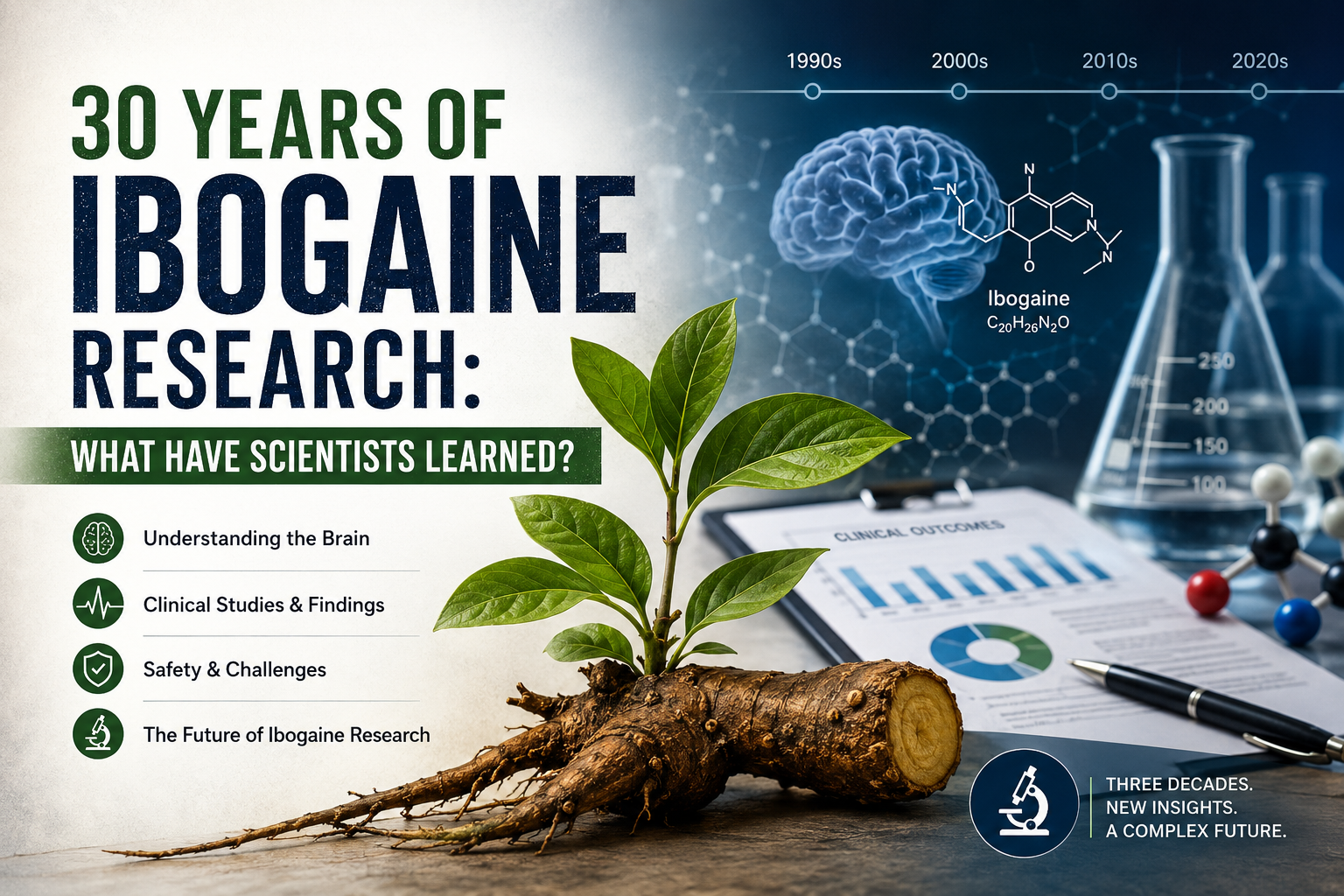
30 Years of Ibogaine Research: What Have Scientists Learned?
Thirty years is a long time in medical research. Yet ibogaine remains one of those unusual compounds that scientists still cannot place neatly into a single category. It has a long history of traditional use, a complicated pharmacological profile, and a modern research record filled with both promising observations and difficult safety questions.
Interest in ibogaine research has largely come from reports involving substance use disorders. People have described changes in withdrawal, cravings, and patterns of drug use after receiving ibogaine. Those reports encouraged scientists to investigate what might be happening biologically.
The picture today is more measured. Researchers have learned considerably more about ibogaine than they knew in the 1990s, but several important questions remain unanswered. Recent reviews suggest that the field has accumulated useful evidence without yet producing the large, well-controlled clinical trials needed to establish ibogaine as an accepted treatment.
How the Modern Research Story Started
Ibogaine did not begin its journey as a pharmaceutical developed in a conventional laboratory. It is a naturally occurring alkaloid found in Tabernanthe iboga, a plant native to Central-West Africa with a much older cultural history.
Modern scientific interest grew partly from reports that ibogaine appeared to affect withdrawal and drug cravings. During the 1990s and following decades, scientists began documenting these observations through animal studies, case reports, open-label investigations, and observational research.
Those early studies were useful because they gave scientists something concrete to investigate. They also had obvious limitations. Small samples, retrospective reporting and a lack of control groups made it difficult to determine how much of an observed improvement could be attributed specifically to ibogaine.
That limitation has shaped ibogaine research ever since. The field has gradually moved from asking “Could something be happening?” toward the much harder question of “Can the effect be demonstrated reliably under controlled conditions?”
Why Ibogaine Has Attracted So Much Scientific Attention
One reason ibogaine research remains interesting is the compound’s unusual pharmacology.
Ibogaine does not appear to act through one simple pathway. Laboratory research has identified interactions involving several neurotransmitter and receptor systems, including opioid, serotonin, glutamate and nicotinic acetylcholine pathways. This broad activity has led scientists to investigate ibogaine as a potentially “multitarget” compound rather than a conventional single-target medicine.
There is another important piece to the puzzle: noribogaine.
Once ibogaine enters the body, it is metabolized into noribogaine. The metabolite can remain in circulation much longer than the original compound, which means the biological story does not end when ibogaine itself starts to disappear.
Human pharmacokinetic research has helped clarify this relationship. Scientists have measured ibogaine and noribogaine concentrations and examined how metabolism differs between individuals. Such work is important because the same administered amount may not produce identical exposure in every person.
For ibogaine research, understanding this metabolism is more than a technical detail. It could influence how future studies approach dosing, safety and treatment response.
What Have Human Studies Actually Shown?
This is probably the part of the subject that attracts the most attention—and where careful interpretation is especially important.
Clinical studies have reported reductions in withdrawal symptoms and cravings in some people with substance use disorders. Researchers have also investigated possible changes in depression, trauma-related symptoms and longer-term substance use.
A 2022 systematic review covering clinical studies up to 2020 identified 24 studies involving 705 people who received ibogaine or noribogaine. The review found encouraging signals around withdrawal and craving, but it also reported serious medical complications and deaths in the published literature.
The quality of the evidence is the key issue.
Many studies were open-label, observational or based on case reports. Participants often knew they were receiving ibogaine, and some were already strongly motivated to stop using drugs. Their surroundings, expectations, psychological support and other aspects of treatment could therefore affect the outcome.
That does not make those studies irrelevant. They can reveal patterns worth testing. But they cannot provide the same certainty as a large randomized controlled trial.
A 2026 literature review looked at three decades of clinical evidence and reached a similar conclusion. It identified 24 clinical studies plus 38 case reports or case series, but noted that much of the positive evidence came from uncontrolled or retrospective research with a high risk of bias. No double-blind randomized trial has established ibogaine or noribogaine as an effective treatment for opioid use disorder.
Noribogaine Changed the Research Conversation
As knowledge of ibogaine metabolism improved, noribogaine became impossible to overlook.
Scientists now study the two compounds together because their effects in the body are closely connected but not identical. Noribogaine has a longer presence in the bloodstream and its own pharmacological activity, making it relevant when researchers try to explain both therapeutic observations and adverse effects.
This has made ibogaine research increasingly sophisticated. Instead of treating the experience as the result of one compound acting for a short period, scientists can examine absorption, metabolism, individual variation and the longer-lasting effects of the metabolite.
That approach may eventually help explain why people respond differently to the same intervention.
Safety Has Become Impossible to Separate From Efficacy
The most difficult chapter of ibogaine research concerns cardiovascular safety.
QTc prolongation is one of the better-documented concerns. In susceptible circumstances, changes in the heart’s electrical activity can increase the risk of dangerous arrhythmias. Published reviews have also described neurological, gastrointestinal and other adverse effects.
Important Safety Consideration
Serious cardiac events have been reported, including ventricular arrhythmias and cardiac arrest. Recent reviews continue to describe cardiotoxicity as one of the major obstacles to wider clinical development.
This is why current ibogaine research increasingly emphasizes medical screening and monitoring rather than focusing exclusively on potential benefits.
A 2023 systematic review of clinical studies concluded that controlled settings, trained professionals, and appropriate medical, psychiatric and cardiac monitoring are important considerations for improving safety.
In other words, safety is not a footnote to the ibogaine story. It is one of the central scientific questions.
The Field Is Starting to Look Beyond Early Addiction Studies
The scope of ibogaine research has gradually widened.
Scientists have investigated the compound in connection with opioid, cocaine, alcohol and polysubstance use, while newer work has also examined psychiatric conditions and related symptoms. A 2026 review describes preliminary interest in conditions including PTSD and polysubstance dependence, although the available evidence remains exploratory.
There is also growing interest in whether ibogaine’s useful pharmacological properties could eventually be separated from its cardiovascular liabilities.
That is an intriguing possibility, but it remains a research goal rather than an established medical solution.
What Should Scientists Focus on Next?
The next phase of ibogaine research needs better-designed human studies.
- Larger and better-controlled participant groups
- Standardized ibogaine preparations and dosing approaches
- Clearly defined clinical outcomes
- Longer follow-up periods
- Detailed cardiovascular assessment
- Better understanding of metabolism and individual responses
- More consistent reporting of adverse events
Researchers also need to understand how metabolism, existing medications and individual cardiovascular differences influence risk.
Recent clinical-trial reviews show that early-stage studies still dominate the field, with considerable variation in dosing approaches, eligibility criteria and safety procedures. Large late-stage trials remain limited.
That leaves researchers with a fairly clear agenda: establish whether the promising signals can survive rigorous testing, while developing better ways to identify and reduce serious adverse events.
Thirty Years Later, the Story Is Still Unfinished
Looking back at three decades of ibogaine research, the most honest conclusion is neither overly optimistic nor dismissive.
Scientists have learned that ibogaine has a remarkably complex biological profile. They have gathered evidence suggesting possible effects on withdrawal and craving, learned more about noribogaine, and identified important safety concerns that cannot be ignored.
At the same time, the clinical evidence remains too limited to support broad claims about effectiveness.
That may actually be the most interesting thing about where the field stands today. Ibogaine has survived decades of scientific scrutiny without becoming either a proven medicine or a forgotten curiosity.
The Road Ahead: The next chapter of ibogaine research will depend on rigorous clinical science: better trials, standardized approaches, careful cardiovascular monitoring and a clearer understanding of who might benefit and who could face unacceptable risks.
After 30 years, scientists have learned quite a lot about ibogaine. The harder—and potentially more important—work is finding out what those discoveries mean in real clinical practice.