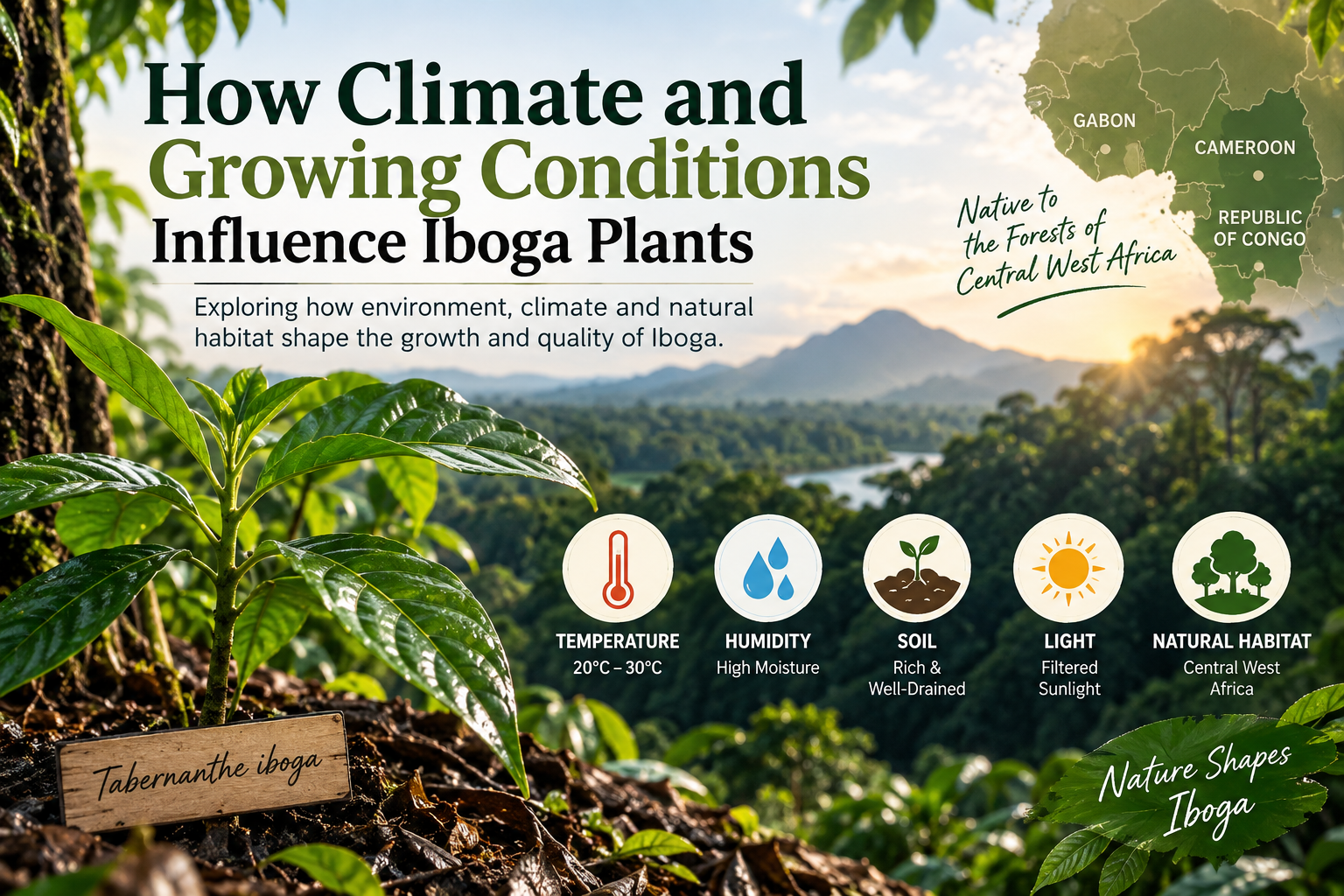
How Climate and Growing Conditions Influence Iboga Plants
Ever notice how some plants grow just about anywhere, while others struggle when conditions change? Iboga falls firmly into the second category. Native to the forests of Central West Africa — particularly Gabon, Cameroon, and the Republic of Congo — Tabernanthe iboga is a slow-growing shrub adapted to a very specific natural environment. Understanding these iboga growing conditions helps explain why the plant can be challenging to cultivate outside its native range and why plants grown in different environments can develop differently.
The Natural Habitat of Iboga
In its natural habitat, Tabernanthe iboga grows beneath the forest canopy rather than in full, direct sunlight. Taller trees reduce the intensity of sunlight, creating the dappled shade and humid conditions that characterize much of the plant’s environment. The surrounding vegetation also contributes to a stable ecosystem where organic material, moisture, and nutrients remain available around the root zone.
These natural conditions provide useful clues about what the iboga plant climate should look like. Stable warmth, relatively high humidity, organic-rich soil, adequate moisture, and filtered light are all important environmental factors associated with its native habitat.
- Warm and relatively stable temperatures
- Consistent atmospheric humidity
- Moisture-balanced, well-drained soil
- Filtered or dappled sunlight
- Organic matter and suitable nutrients
Temperature Requirements for Healthy Iboga Growth
Temperature is an important consideration when growing iboga outside its natural environment. The plant generally prefers warm, stable conditions, with temperatures around 20°C to 30°C (68°F to 86°F) being suitable for active growth. Significant fluctuations between daytime and nighttime temperatures can place additional stress on young or developing plants.
Cold conditions are particularly problematic. Iboga is a tropical plant and is not adapted to frost or prolonged freezing temperatures. In cooler climates, growers may therefore need a controlled environment such as a greenhouse or indoor growing space to maintain appropriate warmth.
Avoid sudden temperature changes and prolonged exposure to cold conditions when maintaining an iboga plant in a controlled environment.
Humidity and Rainfall Patterns
Humidity is another important part of the iboga growing environment. The plant originates from humid forest ecosystems where moisture is regularly available throughout much of the year. Consistent moisture in the surrounding air can help support healthy foliage and reduce the stress associated with excessively dry conditions.
In dry indoor environments, maintaining suitable humidity can be challenging. Depending on the growing setup, growers may use appropriate humidity-control methods to create a more stable environment. At the same time, excessive moisture around the roots should be avoided because poor drainage can create conditions that encourage root problems.
Soil Composition and Drainage for Iboga Plants
Soil quality plays an important role in maintaining healthy iboga growth. The plant is associated with forest environments containing organic material and naturally developed soils. For cultivation, a loose growing medium with good drainage can help prevent water from remaining around the roots for extended periods.
Heavy, compacted soil can retain excessive water and reduce air movement around the root system. A well-draining medium combined with suitable organic matter can provide a more appropriate growing environment.
Soil pH is another factor worth considering. A slightly acidic to neutral range of approximately 5.5 to 6.5 is commonly cited for iboga cultivation. Organic materials such as properly prepared compost or leaf-based material may also help create a nutrient-rich growing medium.
Light Exposure and Forest Canopy Conditions
The natural habitat of iboga provides another important clue: the plant typically develops beneath a forest canopy. This means it is accustomed to filtered and dappled light rather than constant exposure to intense direct sunlight.
Excessive direct sunlight can increase leaf and soil temperatures and may contribute to plant stress. For this reason, partial shade or filtered light can more closely resemble the conditions found in its natural forest environment.
When growing iboga indoors, the location and intensity of available light should be considered carefully. A setup that provides bright but indirect or filtered light may be more appropriate than placing the plant directly in intense sunlight for extended periods.
How Climate Can Influence Iboga Plant Chemistry
Climate can influence more than just the visible growth of a plant. Temperature, water availability, light exposure, soil conditions, plant age, and other environmental factors can influence plant physiology and secondary metabolite production.
Iboga contains naturally occurring alkaloids, including ibogaine, and the chemical profile of plant material can vary between individual plants and growing conditions. Genetics, maturity, environmental stress, and other factors can all contribute to this variation.
Environmental conditions should not be used as a reliable method for predicting the alkaloid concentration or chemical profile of iboga material. Laboratory analysis is necessary when precise chemical composition needs to be established.
Challenges of Growing Iboga Outside Its Native Range
Recreating the natural iboga plant growing conditions outside Central West Africa can be challenging. Temperature fluctuations, low humidity, unsuitable soil, poor drainage, excessive sunlight, and seasonal changes can all affect plant development.
Indoor and greenhouse cultivation can provide greater environmental control, but maintaining stable conditions requires ongoing attention. Even when the basic requirements are met, iboga remains a relatively slow-growing plant, meaning that successful cultivation requires patience and consistent care.
- Cold temperatures and sudden temperature changes
- Very low humidity
- Waterlogged or poorly draining soil
- Excessive direct sunlight
- Inconsistent moisture levels
- Slow growth and long maturation periods
Final Thoughts on Iboga Growing Conditions
Climate is a major factor in the development of iboga plants. Temperature, humidity, soil, water availability, and light exposure all contribute to the environment in which the plant grows. Understanding the natural habitat of iboga provides useful insight into why the species can be challenging to cultivate in climates that differ significantly from Central West Africa.
For anyone interested in learning more about iboga plants, understanding their ecological requirements is an important starting point. A stable and carefully managed environment can help support healthy plant development while providing a closer approximation of the conditions found in the species’ natural habitat.