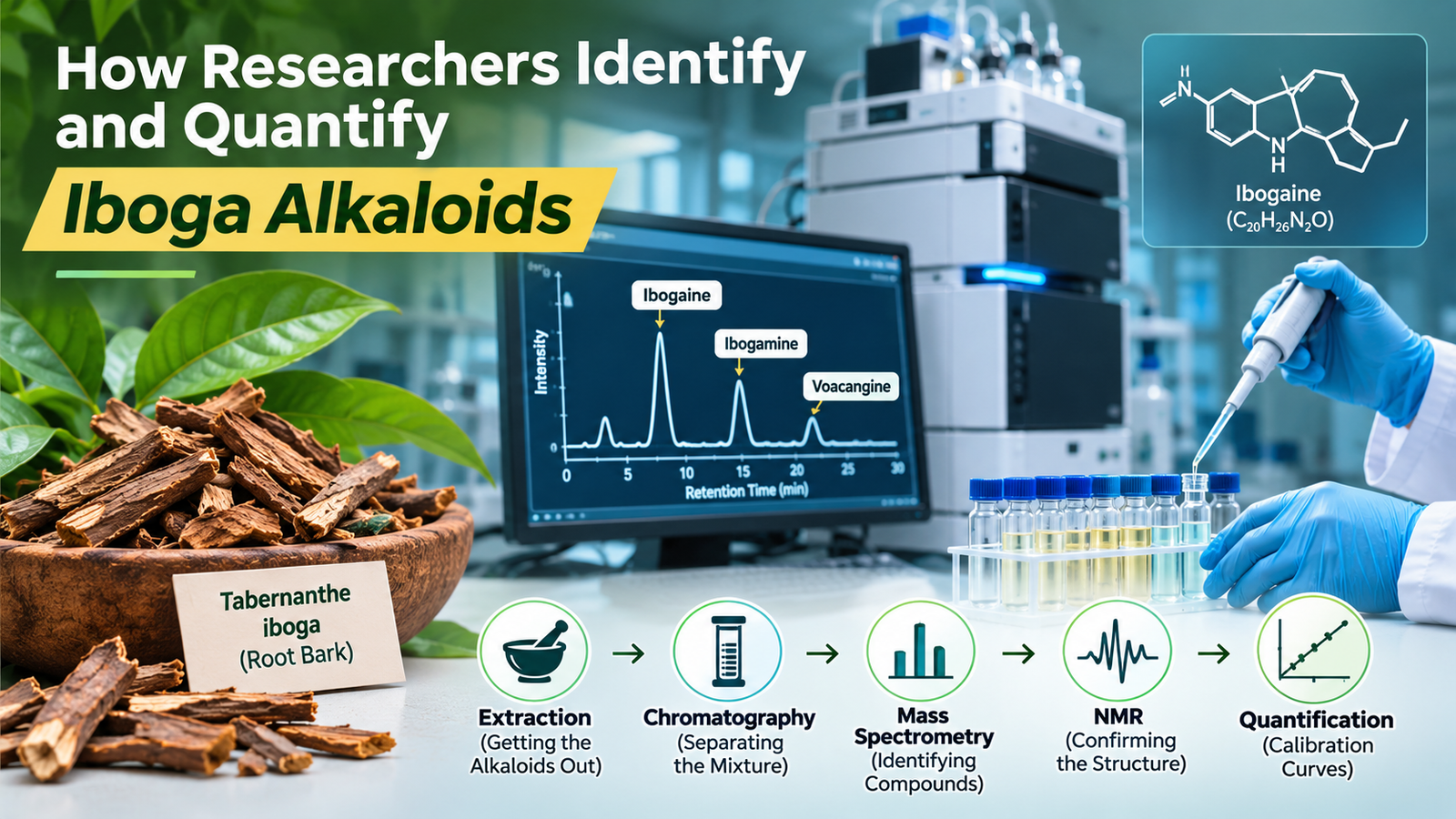
How Researchers Identify and Quantify Iboga Alkaloids
If you’ve ever wondered how a lab tells one plant extract from another, iboga makes a great case study. The root bark of Tabernanthe iboga holds a crowded mix of compounds, and sorting through them takes patience, solid equipment, and a lot of careful method development. Researchers working with iboga alkaloids aren’t satisfied with a simple “yes, it’s in there.” They want to know exactly which compounds are present and how much of each.
Here’s a plain-language walkthrough of how iboga alkaloids are identified and quantified, step by step.
Why Testing Iboga Alkaloids Accurately Matters
Iboga root bark can contain dozens of related molecules. Ibogaine gets most of the attention, but ibogamine, voacangine, ibogaline, and tabernanthine show up too. Their structures are so similar that telling them apart is a bit like sorting identical twins by their handwriting.
Accuracy matters because the profile of iboga alkaloids shifts from plant to plant. Age, soil, harvest time, and storage conditions all change the numbers. Without solid testing, you can’t really compare one batch to the next, confirm purity, or feel confident in the data you collect.
Step 1: Getting the Alkaloids Out of the Bark
Good results start long before the instruments are switched on. Dried root bark is ground into a fine powder so the solvent can reach the plant material evenly. Researchers then pull the iboga alkaloids out using a solvent such as methanol or ethanol, or with a classic acid-base extraction.
Acid-base extraction works because alkaloids are basic compounds. Changing the pH lets the lab move them between water and an organic solvent, which leaves most fats, sugars, and pigments behind.
Once extracted, the liquid is filtered, often through a 0.22 or 0.45 micron filter, so nothing clogs the instruments downstream.
Step 2: Separating the Mixture with Chromatography
A raw extract is a tangle. Chromatography untangles it.
High-performance liquid chromatography (HPLC) is the workhorse for iboga alkaloids. The extract is pushed through a column packed with tiny particles, and each compound travels at its own pace. The time a compound takes to come out is called its retention time, and it’s the first clue to what it is. Reversed-phase C18 columns are popular, usually paired with water, acetonitrile, and a little formic acid.
Step 3: Identifying Compounds with Mass Spectrometry
Retention time alone isn’t proof. Two different molecules can leave the column at nearly the same moment, so most labs pair their chromatography with mass spectrometry (LC-MS).
A mass spectrometer measures the mass-to-charge ratio of each molecule. Tandem MS (MS/MS) goes a step further by breaking the molecule into fragments, and that fragment pattern works like a fingerprint. High-resolution instruments like Q-TOF and Orbitrap measure mass to several decimal places, and that extra precision is what lets analysts tell apart close cousins in the iboga alkaloids family.
Last comes the cross-check. The lab runs a certified reference standard under the same conditions, and if the retention time, mass, and fragments all line up with it, the compound is confirmed.
Step 4: Double-Checking the Structure with NMR
Sometimes a peak turns up that nobody expected, or a lab needs to confirm a compound before using it as a reference material. That’s when researchers reach for nuclear magnetic resonance (NMR). It’s slower and needs more sample than LC-MS, so it’s rarely used for routine batch checks. Still, it’s the tool that settles arguments about the structure of iboga alkaloids.
Step 5: Quantifying Iboga Alkaloids with Calibration Curves
Identification tells you what is in the sample. Quantification tells you how much. For measuring iboga alkaloids, the usual approach is a calibration curve.
The lab prepares several solutions of a reference standard at known concentrations and runs each one. Plotting peak area against concentration gives a straight line. Then the sample is run, its peak area is read off that line, and the concentration falls out. Many labs add an internal standard, a known compound spiked into every sample, to correct for small changes between runs.
Results are usually reported as milligrams per gram of dry bark or as a percentage of dry weight. The content of iboga alkaloids can differ widely depending on the plant material, so reporting the basis clearly is important.
Method Validation: Can You Trust the Numbers?
A method only counts once it has been validated. Guidelines such as ICH Q2 lay out the checks most labs follow:
- Linearity: Does the response rise in step with concentration?
- Accuracy and recovery: Does the method find what was actually added?
- Precision: Do repeat runs give similar results?
- Specificity: Can it tell the target from lookalikes?
- LOD and LOQ: What’s the smallest amount it can detect and reliably measure?
Validation is what makes results repeatable, so a number measured this month still means something next year. That’s the whole reason to quantify iboga alkaloids with care.
What Makes Iboga Alkaloids Tricky to Test?
Even seasoned analysts hit snags with iboga alkaloids. These are the usual ones:
- Reference standards: Good ones cost a lot, can be hard to track down, and in some countries they’re tightly controlled.
- Matrix effects: Other compounds in the bark can quietly dull or inflate the signal in LC-MS.
- Stability: Samples don’t age well. Light, warmth, and time all break them down, so most labs keep extracts cold and in the dark.
- Natural variation: No two roots are exactly alike, so sampling needs careful planning.
Final Thoughts
Studying iboga alkaloids is a mix of chemistry and craftsmanship. Each technique answers a different question, and together they give a trustworthy picture of what’s in a sample. If you read a lab report on iboga alkaloids, look for the method used, the reference standards, and the validation data. Those details tell you how much weight the numbers deserve.
Looking for More Information About Iboga Root Bark?
Understanding the natural composition, sourcing considerations, and quality characteristics of Tabernanthe iboga requires reliable information. Connect with our team to learn more about iboga root bark, product information, and available sourcing details.
Get in touch for product-related information and general inquiries.