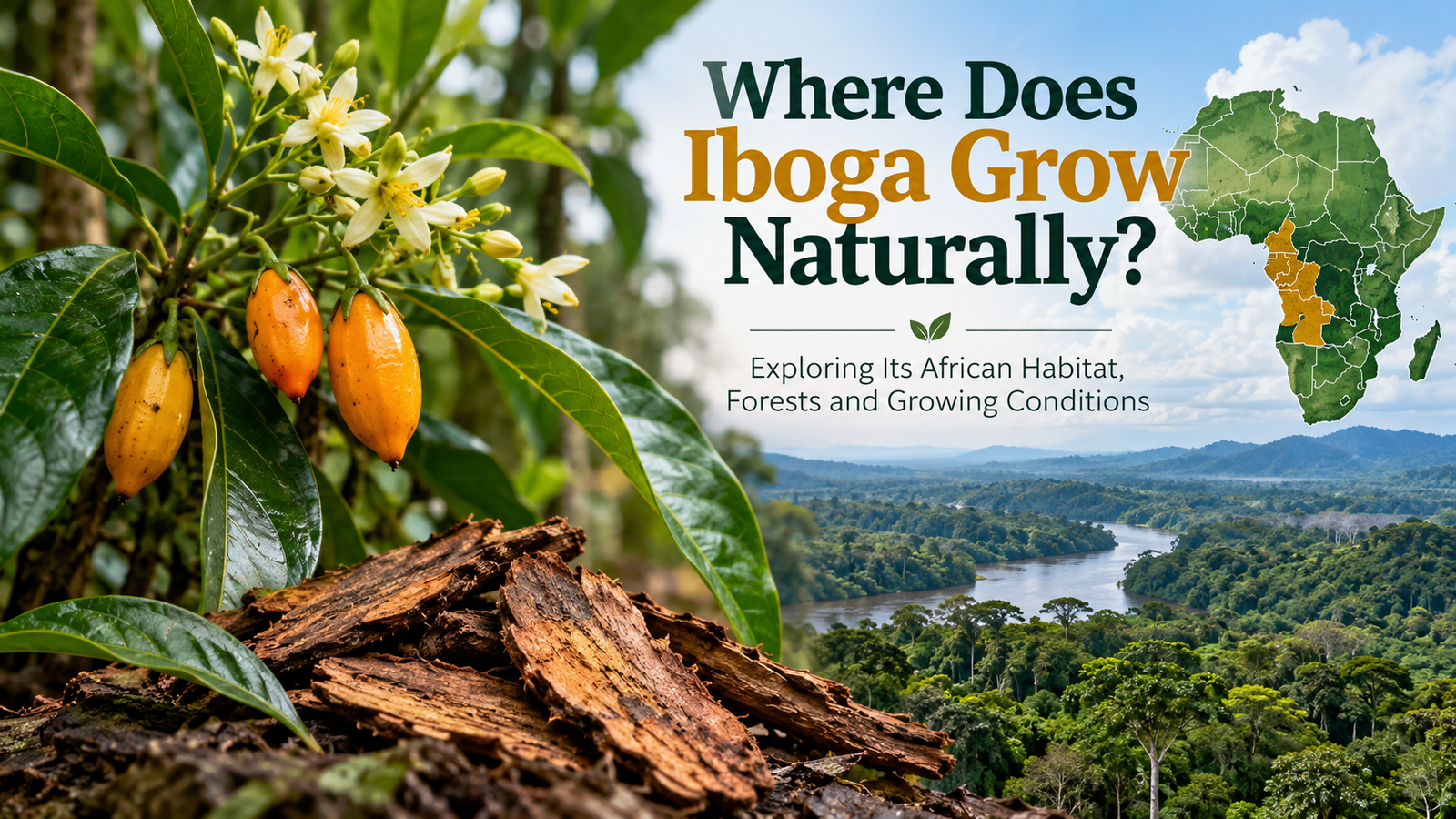
Where Does Iboga Grow Naturally? A Geographic Guide to Central Africa
If you have read anything about the iboga plant, you have probably noticed a pattern. Almost every article says it comes from Africa, but very few explain where. Central Africa is a huge region, so that answer isn’t much help. This guide gets specific. We’ll look at the countries, forests, and growing conditions that answer the question, where does iboga grow naturally, and why only certain corners of the continent suit it.
What Is Iboga?
Iboga (Tabernanthe iboga) is a perennial shrub that belongs to the dogbane family, the same group that includes frangipani. Most plants stay around one to two metres tall, although older ones can grow taller where conditions are good. The leaves are long and glossy, the small flowers are whitish-yellow, and the fruit ripens to a bright orange-yellow. People in the region have traditionally used the root bark, but this article sticks to geography and ecology rather than use.
Gabon: The Heart of the Iboga Range
Ask any botanist where iboga is most at home and the answer is Gabon. Close to 90 percent of the country is covered in forest, and the humid understory suits this shrub perfectly. You’ll find iboga growing wild across the western and central provinces, including the forests around Libreville, the Ogooué valley, Ngounié, and the northern Woleu-Ntem region.
The plant also carries deep cultural weight here. The Fang and Mitsogo peoples have long used iboga in Bwiti, a spiritual tradition that treats the plant with real reverence. That respect is one reason iboga is still tended in village gardens and protected near sacred sites, not just left to chance in the wild. In some villages, families keep a few plants close to home, so the line between wild and cultivated growth is often blurry.
Beyond Gabon: The Wider Natural Range
Gabon gets most of the attention, but the shrub’s natural range spills over its borders. In southern Cameroon, it grows in lowland forests close to the Gabon and Equatorial Guinea borders. The mainland part of Equatorial Guinea, known as Río Muni, shares the same forest belt. Moving east and south, the plant turns up in the western forests of the Republic of Congo and in parts of the Democratic Republic of the Congo. There are also scattered reports from Angola’s Cabinda enclave.
The easiest way to picture it is as one broad green corridor along the western edge of the Congo Basin rather than a set of separate national patches. Political borders mean very little to a forest plant. Rainfall, shade, and soil matter far more.
What Kind of Forest Does Iboga Need?
Iboga is a rainforest specialist, and it can be fussy about its surroundings. In the wild, the habitat usually looks like this:
- Temperature: Warm and steady, roughly 22 to 30°C through the year.
- Rainfall: Heavy and reliable, often well above 1,500 mm annually.
- Light: Dappled shade beneath taller trees, not open sun.
- Soil: Loose, well-drained, slightly acidic, and rich in rotting leaf litter.
- Elevation: Mostly lowland and low hills.
Frost kills it, and waterlogged ground rots its roots. That narrow comfort zone explains why the plant sticks to the equatorial belt instead of spreading across the continent.
Wild Growth Versus Cultivation
Most iboga still comes from wild forests or small village plots rather than large plantations. The reason is simple: it grows slowly. Plants are often said to need several years, in some accounts close to a decade, before the roots reach a harvestable size. That doesn’t fit well with industrial farming schedules.
A few growers in tropical regions outside Africa, mostly in greenhouses or sheltered gardens, have tried raising the shrub from seed. Results vary, and it takes patience plus a stable, warm, humid climate. Seeds also reportedly lose viability fairly quickly, which adds another hurdle.
Conservation and Sustainable Sourcing
Rising international interest has put pressure on wild populations. Conservation groups have raised concerns about overharvesting, particularly because the roots are dug up and the plant takes so long to regrow. Gabon has introduced rules on harvesting, export, and benefit-sharing so that local communities are not left out. Some community projects also focus on replanting in village gardens, which eases pressure on the forest.
Anyone researching the topic, whether for study or plain curiosity, should treat sourcing claims with care. A label like “wild-harvested” tells you very little about whether the plant was gathered responsibly.
Why the Geography Matters
Knowing where iboga grows does more than satisfy curiosity. It explains why supply is limited, why the plant is so closely tied to Gabon’s culture, and why overharvesting is a genuine risk. A shrub that needs a specific climate, slow growth, and intact forest can’t simply be scaled up on demand.
It’s also worth remembering that the legal status of iboga varies a lot from country to country. Some places regulate it strictly, while others have no clear rules. This article is for general education only and isn’t medical or legal advice, so anyone thinking about importing or handling plant material should check local laws first.
Final Thoughts
So, where does iboga grow naturally? Mainly in the lowland rainforests of Gabon, with extensions into Cameroon, Equatorial Guinea, the Republic of Congo, the DRC, and possibly Angola. It’s a plant shaped by warm, wet, shaded forest and by the communities who have looked after it for generations.
If you want to learn more, start with Gabon’s forests and the Bwiti tradition, and look for sources that are open about where their information comes from.
Contact Us for More Information
Have questions about iboga, its natural origins, or sourcing information? Get in touch with our team to learn more.