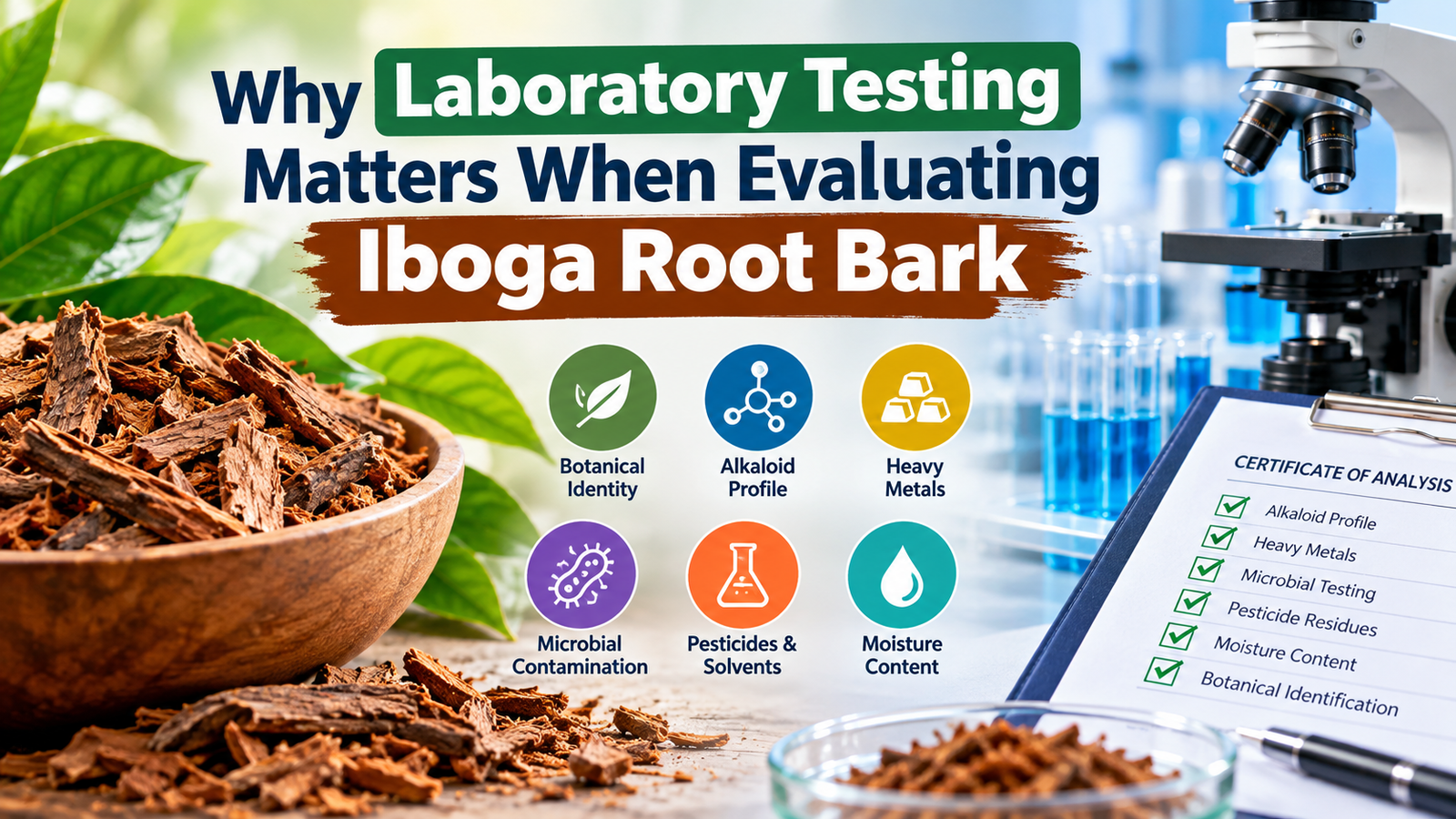
Why Laboratory Testing Matters When Evaluating Iboga Root Bark
If you’ve ever compared two suppliers of iboga root bark, you’ve probably noticed how little a product label can tell you. Two bags may both be described as “pure” or “premium”, yet their botanical identity, composition, handling history and contamination risks may differ. This is why independent laboratory testing and batch-specific documentation matter when assessing iboga root bark.
This guide explains the types of tests that may be used to assess botanical identity and product quality, why transparent documentation is important, and what to look for when reviewing a Certificate of Analysis (COA).
Why the Quality of Iboga Root Bark Can Vary
Iboga root bark comes from Tabernanthe iboga, a plant native to Central Africa and associated with traditional Bwiti practices in Gabon. As with other botanical materials, its characteristics can vary according to plant maturity, growing conditions, harvest practices, drying methods and storage.
Supply-chain practices can add further uncertainty. Poor handling, unsuitable storage, substitution or inaccurate labelling may affect the identity and condition of botanical material. Appearance alone cannot reliably establish what a batch contains or whether it is free from contaminants.
What Laboratory Testing Can Assess
Testing should be selected according to the material, its processing history and the risks that need to be assessed. Common areas of laboratory evaluation include:
Botanical Identity
Identity testing, which may use microscopy, DNA-based methods or other validated botanical techniques, can help determine whether a sample is consistent with the declared plant species. The method used should be appropriate for the condition of the sample.
Alkaloid Profile
Analytical techniques such as high-performance liquid chromatography (HPLC) may be used by qualified laboratories to characterise certain naturally occurring alkaloids. Results should be interpreted by appropriately qualified professionals; an alkaloid profile is not proof of safety, purity or suitability for human consumption.
Heavy Metals
Plants can take up elements from their growing environment. Depending on the source, a laboratory may screen for contaminants such as lead, arsenic, cadmium and mercury. A useful report identifies the method, measured results and relevant reporting limits.
Microbial Contamination
Moisture, drying conditions, packaging and storage can influence microbial quality. Depending on the applicable testing standard, screening may include indicators such as total microbial count, yeast and mould, and specified harmful microorganisms.
Pesticide Residues and Residual Solvents
Where relevant to cultivation or processing, testing may assess pesticide residues or residual solvents. The appropriate panel depends on how the botanical material was grown, handled and processed.
Moisture and Storage Condition
Moisture measurement can help assess storage stability and the potential for mould growth. It should be considered alongside packaging, storage conditions and the date the sample was tested.
Why Relying on Untested Material Is Risky
A supplier description or attractive product presentation cannot replace analytical evidence. Without suitable testing, buyers may have limited information about botanical identity, contamination, batch consistency or handling conditions.
There are also important health considerations. Iboga and ibogaine can cause serious adverse effects, including potentially dangerous changes to heart rhythm, and may interact with medicines or underlying health conditions. Laboratory testing does not make a product safe to consume and cannot replace medical assessment or supervision.
How to Review a Certificate of Analysis
A Certificate of Analysis (COA) summarises the tests performed on a particular sample. When reviewing one, consider the following points:
- Laboratory identity: Check the laboratory name, contact details and relevant accreditation. ISO/IEC 17025 accreditation can be useful, but confirm that the specific test is within the laboratory’s accredited scope.
- Sample and batch details: The report should identify the sample and, where applicable, the batch or lot it represents. Check that these details match the material being discussed.
- Testing date: Confirm when the sample was received and tested. A report for an older or different batch may not describe current stock.
- Methods and reporting limits: Look for the analytical methods, units, detection or quantification limits, and any pass/fail criteria used.
- Results and interpretation: Results should be clearly presented, with units and explanations where needed. Avoid relying on vague claims such as “lab tested” without supporting documentation.
A clear, verifiable and batch-specific COA makes it easier to assess what was actually tested. If any information is missing or unclear, ask the supplier or laboratory for clarification.
Questions to Ask a Supplier
Before making a purchasing decision, consider asking:
- What is the documented botanical source and origin of the material?
- Is a COA available for the specific batch being offered?
- Which independent laboratory conducted the tests?
- Which analytical methods and contaminant panels were included?
- How was the material dried, packaged and stored?
- Can the report and batch details be independently verified?
Suppliers should be able to explain their sourcing and quality documentation clearly. Be cautious about unsupported purity claims, generic certificates or pressure to make a quick decision.
Safety and Legal Considerations
Laws governing iboga and ibogaine vary by country and can change. Check current regulations with the relevant official authorities in your location before buying, possessing, importing or transporting any related material. Do not assume that rules applying to one country also apply elsewhere.
Iboga and ibogaine are associated with potentially serious health risks, including cardiac effects and interactions with medicines. This article is for general educational purposes only and is not medical advice. Do not use this information to self-diagnose, self-treat or plan unsupervised use. Speak with a qualified healthcare professional about health-related concerns.
Final Thoughts
Laboratory testing can provide useful evidence when evaluating iboga root bark. Depending on the sample and the tests performed, it may help assess botanical identity, selected chemical characteristics and possible contaminants. A batch-specific Certificate of Analysis also gives buyers a clearer basis for asking questions and checking supplier claims.
Testing is one part of responsible quality assessment, not a guarantee of safety. Look for transparent sourcing information, relevant independent testing and documentation that can be verified. Above all, keep the health risks and local legal requirements in mind.